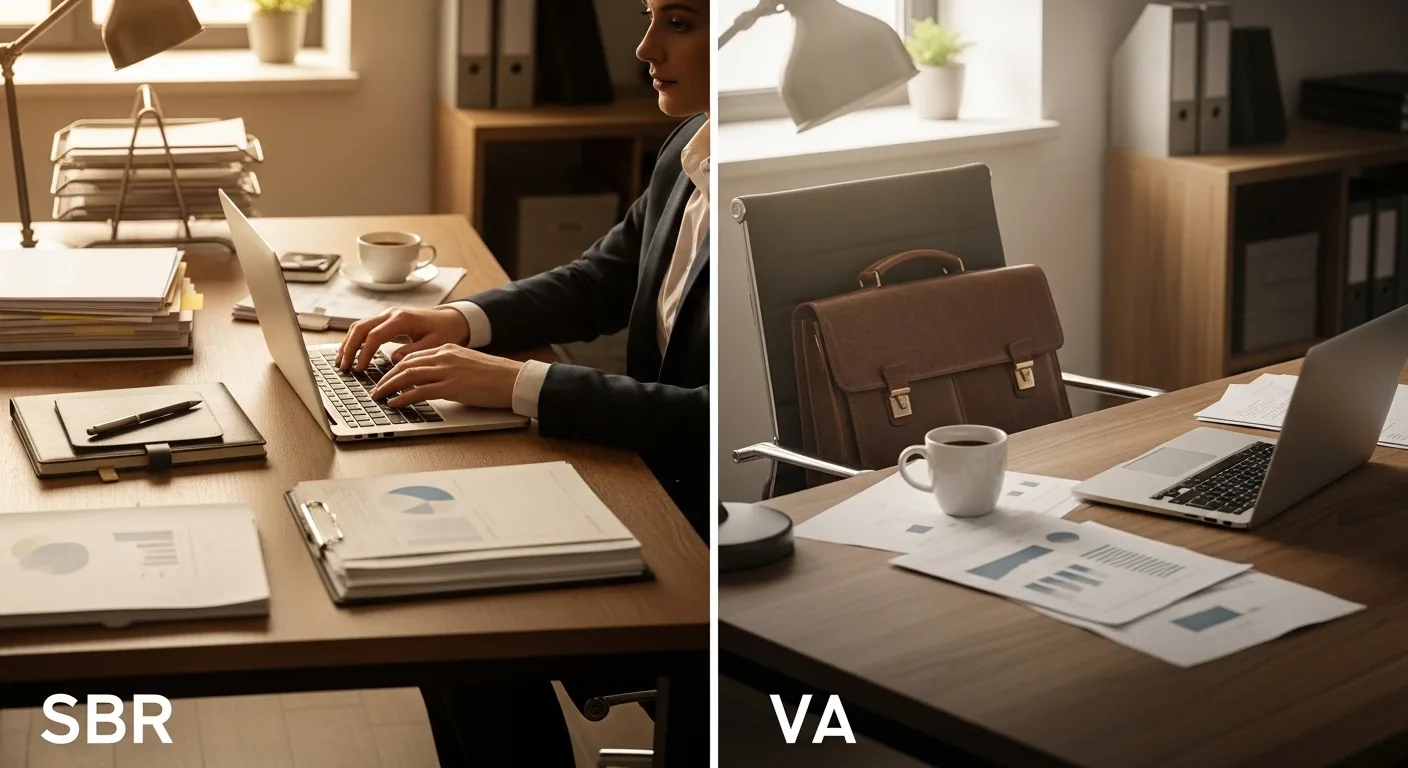
TL;DR: Small Business Restructuring (SBR) costs $15,000-$30,000 vs Voluntary Administration’s $50,000-$150,000+, has an 87% plan approval rate, and lets directors stay in control. 93% of businesses continue trading post-SBR. SBR is limited to Pty Ltd companies with under $1M in liabilities; VA suits larger or more complex restructures.
Both Small Business Restructuring (SBR) and Voluntary Administration (VA) are formal insolvency processes that can help struggling businesses. But they’re very different — and for most small businesses, SBR is the better option.
Here’s a detailed comparison.
The Core Difference Between SBR and Voluntary Administration
SBR: You stay in control while restructuring debts VA: An external administrator takes control of your business
This fundamental difference affects everything else.
SBR vs VA Side-by-Side Comparison Table
| Factor | SBR | Voluntary Administration |
|---|---|---|
| Who’s in charge | You (the director) | External administrator |
| Typical cost | $15,000-$30,000 | $50,000-$150,000+ |
| Timeline | 35 business days | 25 business days + DOCA |
| Eligibility | Under $1M debt, Pty Ltd | Any company, any size |
| Outcome options | Restructuring plan | DOCA, liquidation, or return to directors |
| Success rate | 87% plan approval | Variable (often leads to liquidation) |
| Business during process | Continues normally | Administrator decides |
| Employee management | You manage | Administrator manages |
| Customer relationships | Maintained by you | May be disrupted |
Why Small Business Restructuring Was Created
Before 2021, small businesses facing insolvency had limited options. Voluntary Administration was designed for larger businesses and came with:
- High costs that small businesses couldn’t afford
- Loss of control that small business owners couldn’t accept
- Complexity that wasn’t necessary for simpler situations
The government introduced SBR specifically to give small businesses a better alternative.
SBR vs VA Cost Comparison: The Numbers
The cost difference is stark:
SBR Costs
- Restructuring phase: ~$16,000 (median)
- Plan administration: ~$6,700 (median)
- Total: $15,000-$30,000
Voluntary Administration Costs
- Administrator’s fees: $30,000-$100,000+
- Legal costs: $10,000-$50,000
- DOCA administration (if applicable): $20,000+
- Total: $50,000-$150,000+
For a small business with $300,000 in debt, spending $100,000 on VA fees (before any payment to creditors) often doesn’t make sense. SBR at $25,000 leaves more for creditors and costs less overall.
Director Control: SBR vs Voluntary Administration
Under SBR
- You remain a director
- You make operational decisions
- You manage employees
- You handle customer relationships
- You access company accounts
- The practitioner assists but doesn’t take over
Under Voluntary Administration
- An administrator takes legal control
- They make decisions about operations
- They may terminate employees
- They manage creditor communications
- Your access may be restricted
- You become an advisor, not the decision-maker
For many business owners, losing control is unacceptable. They’ve built something and know it best. SBR respects this.
SBR vs VA Process Timeline Comparison
The SBR Process
Day 1: Appoint restructuring practitioner Days 1-20: Restructuring phase
- Practitioner investigates affairs
- You continue running the business
- Together, develop a restructuring plan
Days 21-35: Creditor voting
- Plan sent to creditors
- 15 business days to vote
- 50%+ by value must approve
If approved: Plan administration (up to 3 years)
- Make agreed payments
- Business continues normally
- When complete, remaining debt released
The VA Process
Day 1: Appoint administrator Days 1-25: Investigation and report
- Administrator takes control
- Investigates company affairs
- Prepares report for creditors
~Day 25: First creditors meeting
- Creditors may vote on administrator
- Direction discussed
~Day 30-35: Second creditors meeting
- Administrator recommends outcome:
- DOCA (company arrangement)
- Liquidation
- Return to directors
If DOCA: Deed administration
- Terms vary widely
- Often takes months to complete
- Additional costs apply
If liquidation: Company ends
The VA process is more complex and outcomes are less predictable.
SBR vs VA Outcomes: What Actually Happens
SBR Outcomes
- 87% of plans approved by creditors
- 93% of businesses continue trading
- Debt typically reduced 60-80%
- Business survives with reduced debt burden
VA Outcomes
- Many companies progress to liquidation anyway
- DOCA outcomes vary significantly
- Higher costs eat into creditor returns
- Business survival less certain
The data strongly favours SBR for small businesses that are genuinely viable.
How SBR and VA Affect Employees
Under SBR
- Employment continues normally
- You manage your team as usual
- No automatic terminations
- Entitlements protected
Under VA
- Administrator decides on staffing
- May terminate employees immediately
- May change conditions
- Disruption is common
If preserving your team matters, SBR is clearly better.
Customer and Supplier Relationships Under SBR vs VA
Under SBR
- You maintain relationships
- Customers may not know
- Suppliers continue as normal
- Contracts generally continue
Under VA
- Administrator communicates with stakeholders
- Customers and suppliers are informed
- Relationships may be damaged
- Contracts may be disclaimed
The reputational impact of VA is typically greater than SBR.
When Voluntary Administration Might Be Necessary Over SBR
Despite SBR’s advantages, VA is still appropriate when:
Debt Exceeds $1 Million
SBR has a $1 million debt cap. Businesses with larger debts must use VA or other processes.
Complex Restructuring Needed
If the business needs fundamental operational restructuring (not just debt reduction), VA’s broader powers may be useful.
Legal Actions Required
If there are claims against directors or voidable transactions to pursue, VA provides mechanisms SBR doesn’t.
Creditor Disputes
If creditors are hostile and unlikely to approve any proposal, VA’s court processes may help.
Business Isn’t Pty Ltd
SBR is only available to Pty Ltd companies. Other structures must use VA or alternatives.
The Director Experience
During SBR
“I felt supported throughout the process. I kept running my business, serving customers, managing staff — it was largely business as usual. The practitioner handled the debt side while I focused on operations. When the plan was approved, it was a huge relief.”
During VA
“The moment the administrator was appointed, I felt like a visitor in my own business. They made decisions I disagreed with. Employees were let go before I thought necessary. It was professionally done, but it wasn’t my business anymore.”
These aren’t unusual experiences. The fundamental difference in control creates different experiences.
Creditor Returns: SBR vs Voluntary Administration
One important metric: what do creditors actually receive?
SBR
- Creditors typically receive 20-40 cents in the dollar
- Lower administration costs mean more for creditors
- Fixed costs make outcomes more predictable
VA
- Returns vary dramatically
- High administration costs reduce distributions
- DOCA terms can be complex
- Liquidation outcomes often under 10 cents
The irony: the cheaper process often returns more to creditors.
Making the Choice
For most small businesses (under $1M debt, Pty Ltd, viable with debt reduction), SBR is the better choice.
Choose SBR when:
- Your debt is under $1 million
- Your business is viable without historical debt
- You want to stay in control
- You want to minimise costs
- Your situation is relatively straightforward
Choose VA when:
- Your debt exceeds $1 million
- Complex restructuring is needed beyond debt reduction
- Legal actions need to be pursued
- You can afford the higher costs
- Your professional advisors recommend it
The Bottom Line
SBR was designed to be VA’s simpler, cheaper, more director-friendly sibling — specifically for small businesses.
For eligible small businesses, there’s rarely a good reason to choose VA over SBR. The control, cost, and outcome advantages of SBR are significant.
If you’re considering VA, ask: “Am I actually eligible for SBR?” If yes, explore that option first.
Related Articles
SBR vs Liquidation: Which Is Right for Your Business?
Should you choose SBR or liquidation? SBR keeps your business trading (93% still operate post-SBR) with 60-80% debt reduction. Liquidation closes permanently with 5-10 cent creditor returns.
ComparisonsSBR vs ATO Payment Plan: Which Should You Choose?
SBR or ATO payment plan? SBR reduces debt 60-80% (pay 20-40 cents/dollar) while payment plans require 100% plus GIC interest. ATO votes yes on SBR plans >90% of the time.
Could SBR Help Your Business?
Check your eligibility in 60 seconds. Free, confidential, and no obligation.
Check Your Eligibility